
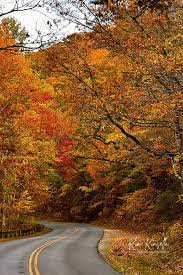
Blue Ridge Parkway fall foliage is the defining visual event of the Appalachian year — and the single most searched travel topic in western North Carolina from August through November. The 469-mile Parkway runs the full spine of the Blue Ridge Mountains from Rockfish Gap, Virginia to Cherokee, North Carolina, threading through some of the most diverse hardwood forest in the world. When that forest turns in October, the effect is staggering: ridge after ridge of crimson, gold, orange, and burgundy stretching to every horizon, with the Parkway ribbon running through the middle of it like a slow-moving front-row seat.
This guide covers everything you need to plan a Blue Ridge Parkway fall foliage trip — when to go, where to stop, how the color moves by elevation, the best overlooks in the NC section, and where to stay to make the most of it.
Blue Ridge Parkway Fall Foliage — At a Glance
Peak timing — high elevations (5,000+ ft): Late September to early October
Peak timing — mid elevations (3,000–5,000 ft): October 10–25 — the sweet spot
Peak timing — lower elevations (under 3,000 ft): Late October through early November
Best single week: October 15–22 for most of the NC Parkway section
First spot to turn: Graveyard Fields (MP 418.8) — often peaks first week of October
Best single overlook: Black Balsam / Tennent Mountain — open balds, unobstructed 360° color
Best fall waterfall hike: Graveyard Fields Loop — two waterfalls framed in crimson
Parkway length in NC: 252 miles (Cherokee to the Virginia border)
Nearest base for northern NC Parkway: Hot Springs NC — 45–55 min from MP 382.6
Parkway closures: Check nps.gov/blri before driving — some sections close for ice or storm damage
How Blue Ridge Parkway Fall Foliage Works — The Elevation Story
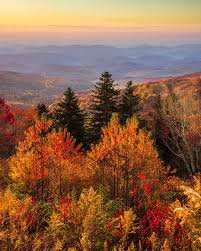
The single most useful thing to understand about Blue Ridge Parkway fall foliage is that it doesn’t peak everywhere at once — it moves. Color begins at the highest elevations in early October and descends to the valley floors by early November. The Parkway itself rises and falls dramatically along its 469-mile length, from under 650 feet at the James River in Virginia to over 6,000 feet near Mount Pisgah in North Carolina. That elevation range means you can chase peak color for weeks by simply driving to the right spot at the right time.
The practical breakdown for the NC section:
The balds above 5,000 feet — Black Balsam, Tennent Mountain, Craggy Gardens, Waterrock Knob — begin turning in late September. By early October they’re often at or past peak, with the grasses turning amber and the surrounding forest going gold. Graveyard Fields at MP 418.8 is consistently the first high-profile spot to turn, often peaking in the first week of October. If you want the earliest color without driving to the highest points, start here.
The mid-elevation Parkway corridor — roughly 3,000 to 5,000 feet, which covers most of the named overlooks and pulloffs — peaks the second and third weeks of October. This is the sweet spot that most foliage guides refer to when they say “mid-to-late October.” The Linn Cove Viaduct section near Grandfather Mountain is widely considered the single best foliage drive in eastern North America and typically peaks October 10–20.
The lower river valleys and towns — Asheville at 2,134 feet, Hot Springs at 1,300 feet, the French Broad River corridor — turn in late October and hold color into early November. From a base in Hot Springs or Asheville, you can watch the color descend off the mountains toward you through the month.
Staying near the Parkway for fall foliage? Windows Over Waterfalls is 45 minutes from the BRP entry — private waterfalls, hot tub, fire pits, and fall color right outside. Check Availability →
Missed peak color? Late fall and the holiday season are open, with the whole property to yourselves. Check open dates.
Best Blue Ridge Parkway Fall Foliage Stops — NC Section
The NC section of the Parkway runs 252 miles from the Virginia border south to Cherokee. These are the stops that consistently deliver the best fall color — organized roughly north to south.
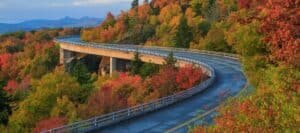 The 22-mile stretch of the Blue Ridge Parkway from the Linn Cove Viaduct to Moses Cone Memorial Park near Blowing Rock is widely ranked the single best fall foliage drive in eastern North America. The Linn Cove Viaduct itself — a feat of engineering that hugs the contours of Grandfather Mountain without a single support post touching the mountain slope — frames the surrounding fall color in a way that photographs don’t fully capture. At MP 304.4, the structure curves around the rock face while the forest below turns gold, orange, and crimson.
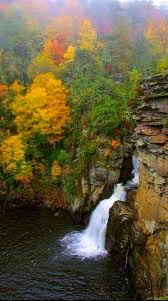 Linville Falls in autumn is a different experience than any other season. The gorge below the falls — Linville Gorge, the deepest gorge in the eastern US — turns deep crimson and burgundy in mid-October while the upper section of the falls catches afternoon light. The Erwin’s View overlook (1.6 miles round-trip from the visitor center) gives the classic high perspective over the falls and gorge; the Plunge Basin Trail descends to the base for a completely different view. Arrive weekdays and early — the parking area fills by mid-morning on October weekends. For our full trail guide, see our
  A 70-foot horsetail waterfall accessible via a moderate 2.5-mile loop from the Parkway at MP 339.5. Less visited than Linville and Graveyard Fields, Crabtree sees dramatically thinner crowds even at fall peak — making it one of the better choices for a quiet waterfall-and-foliage hike without fighting for parking. The loop trail passes through dense hardwood forest that turns a deep, warm orange in mid-to-late October. The surrounding ridges at this elevation (approximately 3,700 feet) hold color well into the last week of October.
 At 6,684 feet, Mount Mitchell is the highest point east of the Mississippi River — and at that elevation, fall color arrives earliest. The summit typically turns the first week of October, making it the earliest major foliage destination on the NC Parkway. Drive NC-128 off the Parkway at MP 355.4 to reach the summit parking area. The views from the observation deck span the Black Mountains, the surrounding ridges turning gold and red below, with Asheville visible in the valley. The spruce-fir forest at the summit itself doesn’t change color the way the hardwoods below do — the show is in the transition zone and the views into the valleys.
 The closest high-elevation foliage stop north of Asheville. Craggy Gardens sits at 5,640 feet in a dense heath of catawba rhododendron that is famous for its June bloom — but October brings its own version of the spectacle. The rhododendron shrubs that cover the ridgeline frame panoramic views of the surrounding mountains in full fall color, with hardwood ridges turning gold and crimson in every direction below. The Visitor Center at MP 364.4 is the starting point; the Pinnacle Trail is 1.4 miles round-trip to a high-elevation viewpoint that earns the drive. Peak timing is early to mid-October — earlier than the lower Asheville-area corridor, and often less crowded than the more famous stops to the south.
 Graveyard Fields is consistently the first major Blue Ridge Parkway fall foliage destination to peak — typically the first week of October, well ahead of the mid-elevation corridor. The mile-high valley at MP 418.8 sits in a natural bowl between 6,000-foot peaks and catches the temperature drops that trigger early color change. The combination of two waterfalls, an open highland meadow, and the surrounding forest turning red and gold makes Graveyard Fields in early October one of the most complete fall foliage experiences on the entire Parkway.
 The best panoramic fall foliage experience on the NC Parkway. At 6,214 feet with a completely open, treeless summit, Black Balsam Knob puts you above the color looking down into it — a perspective almost nothing else in the eastern US can match. The surrounding balds turn amber while the forest below goes crimson and gold in every direction. On clear days, the Smokies, Looking Glass Rock, and the Pisgah ridge all emerge from a sea of fall color. The short approach from Black Balsam Road (just off the Parkway at MP 420.2) is less than a mile to the summit. Continue the ridge walk to Tennent Mountain and Sam Knob for nearly 3 miles of open bald walking above the treeline with color on every horizon. Arrive early — parking disappears fast on October weekends. For full hiking details, see our
  Waterrock Knob hosts the highest visitor center on the entire Blue Ridge Parkway, sitting at 5,820 feet with the summit reaching 6,292 feet via a 1.2-mile round-trip trail — and one of the most dramatic sunrise overlooks in the southern Appalachians. In fall, the views from the parking area — which require no hiking — sweep across the Great Balsams, the Great Smokies, the Craggies, and more, with the ridges below turning color in sequence through October. The short summit trail (0.5 miles) gains additional elevation for an even more expansive view. Sunset and sunrise here in mid-October are genuinely extraordinary — photographers plan trips around this specific overlook and this specific window.
Practical Tips for Blue Ridge Parkway Fall Foliage
Before You Go — What Experienced Fall Visitors Know
Book lodging months in advance: October weekends in western NC sell out fast — sometimes by August. If you’re visiting peak week (October 15–22), book now.
Weekdays are dramatically better: The same overlook that has a 30-minute parking wait on Saturday morning may be empty on Tuesday. If your schedule allows, plan for Monday–Thursday.
Arrive early: Popular stops like Graveyard Fields, Black Balsam, and Craggy Gardens fill their parking areas by 9–10am on fall weekends. Sunrise arrivals get the best light and the emptiest lots.
Check closures: The Blue Ridge Parkway closes sections for ice, storm damage, and maintenance. Check nps.gov/blri before driving — about 11 miles remain closed for Helene repairs as of October 2026, and the National Park Service expects the North Carolina section to be fully open by the end of 2026.
No GPS for mileposts: The Parkway uses mileposts, not street addresses. Download the official Blue Ridge Parkway app or use AllTrails, which lists parking areas by milepost.
The color is unpredictable: Peak timing can shift by 1–2 weeks depending on summer rainfall, temperature swings, and frost timing. No forecast is guaranteed. Build flexibility into your plans.
Lower elevations last longer: If you miss peak at the high elevations, the river valleys and towns below 3,000 feet hold color through late October and into November.
When Is the Best Time to See Blue Ridge Parkway Fall Foliage?
The honest answer is that there is no single “best week” — only the best week for the elevation you’re targeting. Here’s a simple decision framework:
Want the earliest possible color? Visit Mount Mitchell or Graveyard Fields in late September to early October. These high-elevation spots are often at or past peak before most people even start thinking about fall foliage drives.
Want the most color across the most stops? Peak colors begin at the highest elevations in early October and progress downward through the end of October on the Blue Ridge Parkway. Target October 10–22 for the broadest coverage across the NC Parkway section.
Want peak week with the least crowds? Visiting on a Monday through Thursday can help you avoid the busiest times. A Tuesday in the third week of October will be dramatically quieter than any Saturday in October, with identical color.
Want the best photography light? Arriving early in the morning or later in the afternoon offers the best lighting conditions. The soft, golden light during these times enhances the vibrancy of the fall colors. Sunrise at Waterrock Knob or Black Balsam in mid-October is in a different category entirely from midday light.
Where to Stay for Blue Ridge Parkway Fall Foliage
 Most visitors base in Asheville — central location, easy Parkway access both north and south, and the most lodging options. For the southern Parkway corridor (Graveyard Fields, Black Balsam, Waterrock Knob), Brevard and Waynesville are closer. For the northern corridor (Linn Cove Viaduct, Linville Falls, Crabtree Falls), the Boone/Blowing Rock area is the natural base — see our fall in Boone NC guide for the full High Country picture.
For something completely different — and significantly better than a hotel for a fall foliage trip — Windows Over Waterfalls is a private waterfall cabin 45–55 minutes from the Blue Ridge Parkway entry near Asheville, set on 4 secluded acres in the mountains above Hot Springs. Multiple waterfalls run the full length of the property. A hot tub sits above the creek. Two fire pits. A 1,600 sq ft deck. And in October, the surrounding forest turns around you while the sound of the creek runs through every night. One booking at a time. No other guests. The whole property is yours. Book direct at windowsoverwaterfalls.com.
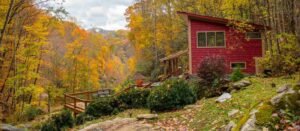 After a day on the Parkway, the Hot Springs mineral springs are 25 minutes from the property — private soaking tubs at 102–103°F on the banks of the French Broad River. The combination of a fall foliage drive, a hot tub soak, and a fire pit evening at a private waterfall cabin is, frankly, the best possible version of a Blue Ridge Mountains fall trip. For everything to do in the Hot Springs area between Parkway drives, see our Hot Springs NC guide. For the best fall hikes in the area, see our Asheville NC hiking guide and our NC waterfalls guide. For the complete western NC fall color picture beyond the Parkway, see our western NC fall foliage guide, our Asheville fall foliage guide, our North Carolina fall foliage guide, and our fall in Boone NC guide.
Airbnb designates this as a top 10% home — their designation, not ours · Guest Favorite · Superhost
What Airbnb Guests Are Saying
★ 4.97
254 Five-Star Reviews
Read the reviews there, then book direct here and skip Airbnb’s guest service fee.
As of October 2026 — and still growing.
Planning a Fall Wedding or Elopement in the Blue Ridge Mountains?
The same property hosts private waterfall ceremonies through our sister site — all-inclusive elopement packages from $4,400 with photography, florals, officiant, hair & makeup, and more.



4 Comments