
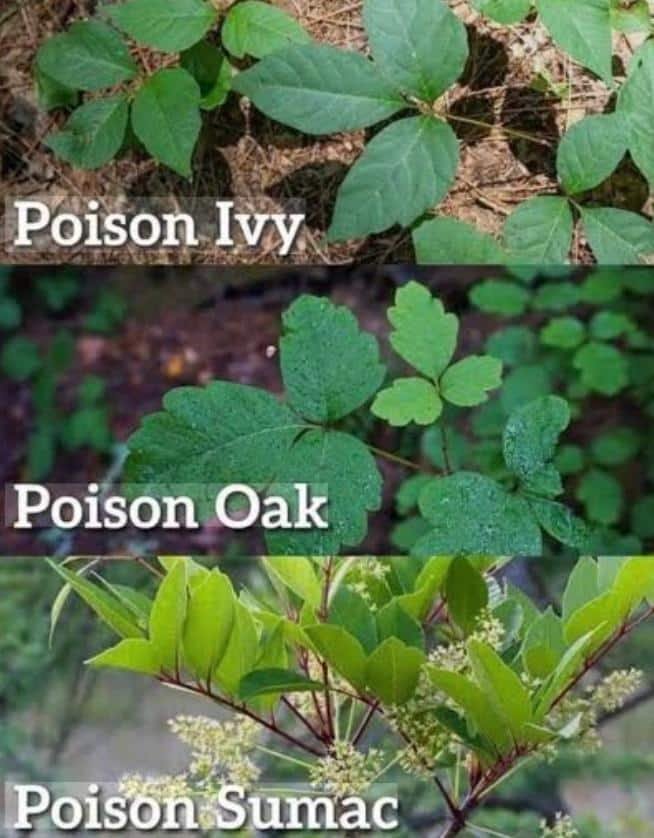
Knowing how to identify poison ivy is one of the easiest outdoor skills to pick up — the plant gives itself away once you know the handful of features to look for. Learn four or five of them and you can spot it from a few feet off, keep your distance, and get on with the hike. This is a field guide written for the Southern Appalachian woods around Hot Springs, North Carolina — the same creek banks, fence rows, and shady trail edges where you are most likely to run across it.
A quick, honest note first: there is no poison ivy on the grounds at Windows Over Waterfalls. (But it could pop up so if you see something, say something; take a photo and let us know where)
We walk the property and pull or treat any that tries to establish itself, so guests should not encounter it near the cabin, the trail, or the creek. The guide below is a just-in-case tool for anyone who likes to wander — and the golden rule is simple: if a plant looks even a little like the description here, treat it as a match and leave it alone. A false alarm costs you nothing.
Quick Poison Ivy Check — Scan Before You Reach
Run through this list before touching any low plant or vine you don’t recognize. The more boxes it ticks, the more you should stay away.
- Leaves of three. Always three leaflets on one stalk — never five. “Leaves of three, let it be.”
- The middle leaflet stands out. The center leaflet sits on its own short stalk and is usually the largest; the two side leaflets are almost stalkless and attach close to it.
- Lopsided side leaflets & veins. The two side leaflets are usually asymmetrical, and their side veins branch off the midvein in a staggered pattern rather than lining up in matched pairs — the middle leaflet is more even. Those unpaired veins are the 2nd most helpful giveaway, since many lookalikes have neatly paired veins.
- No thorns. Edges vary a lot: smooth, toothed, or with a few lobes, even on the same plant. Surface is often glossy above, paler below.
- Hairy climbing vine. When it climbs a tree, the vine looks fuzzy or rope-like with fine aerial roots — “hairy vine, no friend of mine.”
- Bonus, if it’s fruiting: small greenish-to-gray-white berries along the stem in fall and winter — “berries white, take flight.” Don’t rely on this one, though: only mature female plants bear fruit and birds strip it fast, so most plants you meet won’t have any.
- Color shifts with the season: reddish new leaves in spring, green through summer, red-orange in fall.
When in doubt, don’t touch. Every part of the plant — leaves, stems, roots, bare winter vines — can cause a rash. Treating a harmless lookalike as poison ivy is always the safe mistake.
What poison ivy actually is
The plant is Toxicodendron radicans, eastern poison ivy, and it is native right across the eastern United States, including all of Western North Carolina. It is at home in exactly the places people walk: shady woodland edges, thickets, stream and creek banks, roadsides, old fence lines, and clearings. NC State Extension puts the identity test plainly — the leaves are “compound leaflets in groups of three,” with the middle one longer than the outer two.
It grows in three forms, which is part of why it fools people. It can trail along the ground as a low plant, stand up as a small shrub in sunnier spots, or climb 20, 40, even 60 feet up a tree trunk as a woody vine. Same plant, three silhouettes — so identify it by the leaves and vine texture, not by its overall shape. The color shifts too: new leaves are often reddish and glossy in spring, green through summer, then red-orange in fall — so color alone never rules it in or out.
How to identify poison ivy: the five features that matter most
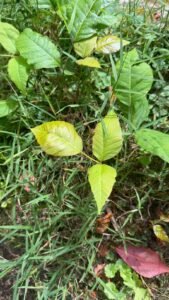
Poison Ivy
If you remember nothing else, remember these.
1. Three leaflets, middle one on a longer stalk. This is the single most reliable cue. Grab the pattern of one center leaflet held out front on its own little stem, flanked by two side leaflets sitting almost flush against the base. If you count five leaflets, it is not poison ivy.
2. Lopsided side leaflets & veins. This is the tell seasoned plant-spotters rely on. On each leaflet, the smaller side veins branch off the central vein in a staggered, alternating pattern — they don’t line up directly across from one another. That makes the two side leaflets look a little asymmetrical, while the middle leaflet is more even. The University of Maryland Extension notes the veins “are generally alternate along the main vein,” and uses that pattern to separate poison ivy from its lookalikes, which tend to have neatly paired veins. Simple rule: if the veins don’t line up, steer clear.
3. Alternate arrangement on the stem. Separate from the veins, there’s how the whole leaves attach. Picture the woody stem as a pole: poison ivy’s three-leaflet leaves stick out one at a time, zig-zagging up it, rather than in matched pairs at the same height. This is a genuinely useful tell — box elder, one of the lookalikes below, carries its leaves in opposite pairs, so whole-leaf arrangement helps tell them apart.
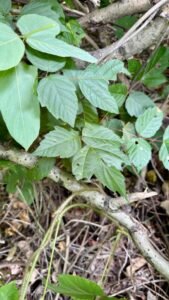
Poison Oak – Same Characteristics
4. No thorns, variable edges. Poison ivy never has thorns or prickles. Its leaf edges are genuinely inconsistent — smooth on one leaf, toothed or lobed on the next. Don’t expect a single tidy leaf shape.
5. A hairy vine. On tree trunks, the mature vine is covered in fine reddish-brown aerial rootlets that give it a fuzzy, hairy-rope look. A smooth or lightly-clinging vine is probably something else. Note that these bare winter vines still carry the rash-causing oil.
Why it causes a rash — and why you never burn it
Every part of poison ivy contains urushiol, an oil that triggers an allergic rash in most people who touch it. The oil is stubborn: it can stay active for months on tools, boots, clothing, and pet fur, so a dog that brushed through it can pass it to you. One rule is non-negotiable in the mountains: never burn poison ivy or brush you can’t identify. Urushiol carries in the smoke and can seriously affect the eyes and lungs.
If You Think You Touched It
- Speed matters most. Washing within about 10 minutes can lift up to half the oil; after 30 minutes most of it has bonded to the skin and rinsing does much less. Don’t wait to find the “right” product.
- Reach for grease-cutting dish soap. Dawn or Dial cuts urushiol the way it cuts kitchen grease. In head-to-head tests, ordinary dish soap worked nearly as well as specialty removers like Tecnu at a fraction of the cost — so whatever’s closest wins. Rubbing alcohol also breaks up the oil.
- Wash gently — don’t scrub. Work up a thick lather with a washcloth and plenty of cool or lukewarm water (not hot), and get under your fingernails. Skip the stiff brush or abrasive pad: hard scrubbing spreads the oil into more skin and irritates it, which makes the rash worse.
- Wash everything else it touched: clothes, boots, gear, and pets carry the oil and can re-expose you. Handle them separately.
- For a mild rash: cool compresses, calamine, or over-the-counter hydrocortisone usually settle the itch.
- Get medical help for a severe or spreading rash, anything on the face or eyes, or any trouble breathing.
Once the oil is gone, you can’t spread it
The rash is an allergic reaction to urushiol, the plant’s oil — not to the rash itself. The fluid in the blisters doesn’t contain urushiol, so it can’t spread the rash to other parts of your body or to anyone else. Once you’ve washed the oil off your skin (and off clothes, gear, and pets), the spreading stops. New patches that show up a day or two later usually mean that spot got more oil, has thinner skin, or you touched something still carrying it — not that the rash is traveling.
One last thing worth knowing: poison ivy is identifiable in every season, not just summer. In winter the leaves are gone, but the bare, hairy vines give it away — and the urushiol stays active year-round, so a leafless vine is still worth avoiding. Don’t expect berries as a reliable sign, though: poison ivy has separate male and female plants and only the females fruit, so many vines never bear any at all. Where they do appear, the grayish-white berries can hang on into winter and are an important food for birds, and the plant supports a range of native insects — so it earns its place in the woods even as you keep your distance.
Three Harmless Lookalikes You’ll See Around Here
- Virginia creeper. Very common in these woods and the plant most often mistaken for poison ivy. It usually has five leaflets, not three (young growth can occasionally show three), bluish berries, and a less hairy vine. Five leaflets = not poison ivy.
- Box elder seedlings. Young box elders have three-to-five leaflets that can look close — but they grow opposite each other on the stem, not staggered, and have no hairy vine or white berries. Common along creek banks.
- Fragrant sumac. Also three leaflets, but the middle leaflet has no stalk — all three attach at nearly the same point — and the berries are red and fuzzy. Harmless.
Remember: mistaking one of these for poison ivy and steering clear costs you nothing. Mistaking poison ivy for one of these is the one to avoid.
Where you’re most likely to meet it in Western North Carolina
Around Hot Springs and the wider Southern Appalachians, poison ivy favors edges: the strip where woods meet a trail or road, sunny gaps in the canopy, stream and creek banks, and old fence rows. It is far less common deep in mature, shaded forest interior. That’s useful on the trail — pay the most attention when you step off a path, reach for a tree to steady yourself, or push through a brushy edge, and you’ll avoid the large majority of encounters.
Heading out to hike while you’re here? Our things to do in Hot Springs guide covers the trails and swimming holes worth your time, and if you’re curious how the private trail on the property was cut into the slope, that story is in building trails on steep terrain.
The short version
Three leaflets with a longer-stalked middle one, staggered up the stem, no thorns, a hairy climbing vine, whitish berries in late summer. That combination is poison ivy. Anything you’re unsure about, treat as poison ivy and give it a wide berth. And at Windows Over Waterfalls specifically, you shouldn’t have to think about it at all — we keep the grounds clear so you can enjoy the waterfalls, the creek, and the trail without watching your ankles.
Airbnb designates this as a top 10% home — their designation, not ours · Guest Favorite · Superhost
What Airbnb Guests Are Saying
★ 4.97
254 Five-Star Reviews
Read the reviews there, then book direct here and skip Airbnb’s guest service fee.
As of October 2026 — and still growing.
Sources & further reading: NC State Extension — Leaves of Three, Let It Be; NC Extension Gardener Plant Toolbox — Eastern Poison Ivy; N.C. Cooperative Extension — Poison Ivy Identification & Control; University of Maryland Extension — How to Identify Poison Ivy. On treatment: American Academy of Dermatology — How to Treat the Rash.