
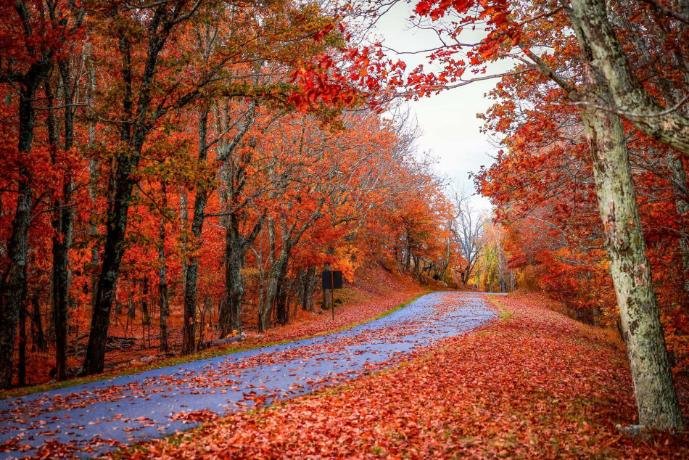
North Carolina fall foliage runs longer, covers more ground, and delivers more variety than any other state on the East Coast — and it isn’t close. The state drops nearly 7,000 feet in elevation from the summit of Mount Mitchell, the highest peak east of the Mississippi, to sea level at the Outer Banks. That vertical range creates a color season that starts at the highest mountain peaks in late September and doesn’t finish until the coastal plain quiets in early November. For six consecutive weeks, somewhere in North Carolina is at or approaching peak fall color. The only question is knowing where to go and when.
This guide covers north carolina fall foliage from the mountains to the Piedmont — the complete picture by region, by elevation, and by week. For visitors who have already decided on the western mountains, we go deeper on the specific corridors that deliver the best color. For visitors still deciding where in the state to go, this guide provides the full map.
North Carolina Fall Foliage — At a Glance
Season length: Late September through early November — nearly 6 weeks statewide
Highest peak: Mount Mitchell — 6,684 ft · Highest point east of the Mississippi
First color statewide: High mountain balds above 5,000 ft · Late September
Peak mountain foliage: October 10–25 across most of western NC
Peak Piedmont foliage: Late October through early November
Best single drive: Blue Ridge Parkway — 252 miles through NC mountain color
Most biodiverse forest: Southern Appalachians — more native tree species than all of northern Europe
Key tree species: Sourwood (scarlet), red maple (crimson), yellow poplar (gold), sassafras (orange), hickory (bronze)
Best real-time tracker: Explore Asheville’s Fall Color Report — updated weekly by local photographers
Best mountain base: Hot Springs NC · Private waterfall cabin 15 min from Max Patch
Why North Carolina Fall Foliage Is Exceptional
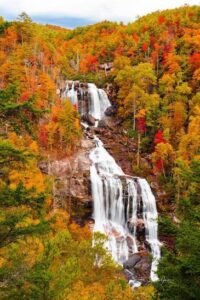 North Carolina’s fall foliage season is longer and more varied than any comparable region in the country for a simple reason: the state’s extraordinary elevation range. No other state east of the Rockies spans as much vertical distance as quickly. Mount Mitchell at 6,684 feet and the Outer Banks beaches at sea level are separated by about 400 miles as the crow flies — but the color they produce is separated by six weeks.
The southern Appalachians are also among the most botanically diverse temperate forests on earth. More native tree species grow in the mountains of western North Carolina than in all of northern Europe combined — a legacy of the Ice Age, when these mountains served as a refugium for plant species that couldn’t survive the advancing glaciers further north. The color palette that results is correspondingly rich: sourwood turns a vivid scarlet before almost anything else in the forest moves. Yellow poplar and birch go gold. Red maple goes crimson. Sassafras turns orange. Hickory goes bronze. Black gum adds deep burgundy. The progression of these species through October creates a color experience that changes week by week and mile by mile.
The science behind it is straightforward. Shortening days trigger trees to stop producing chlorophyll, allowing the underlying pigments to emerge. Warm, sunny days paired with cool nights produce the most vivid colors — the temperature differential accelerates the process. At higher elevations, where nights cool earlier, the process starts sooner. This is why understanding elevation is the key to timing any North Carolina fall foliage trip.
Want private fall color in the NC mountains? Windows Over Waterfalls has waterfalls, fire pits, and fall color from every window. Check Availability →
North Carolina Fall Foliage by Region
Western NC Mountains — The Heart of the Season
Western North Carolina is where most people mean when they search for north carolina fall foliage — and for good reason. The combination of the Blue Ridge Parkway, Pisgah and Nantahala National Forests, the Great Smoky Mountains, and dozens of small mountain towns creates the most concentrated and visually dramatic fall foliage landscape in the eastern United States.
The color follows elevation down through October. The high balds above 5,000 feet — Graveyard Fields, Black Balsam Knob, Craggy Gardens, Max Patch — begin turning in late September and often peak the first week of October. The mid-elevation Blue Ridge Parkway corridor peaks October 10–22. The river valley towns — Asheville at 2,134 feet, Hot Springs at 1,300 feet — peak in the last two weeks of October and hold into early November.
The key destinations in western NC:
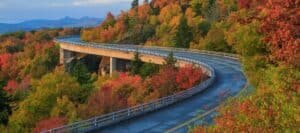
Linn Cove Viaduct
Blue Ridge Parkway — The 252-mile NC section is America’s most visited national park unit and the defining fall foliage drive in the state. From the Linn Cove Viaduct near Grandfather Mountain in the north to Waterrock Knob above the Smokies in the south, the Parkway threads through the most dramatic high-elevation color in the East. For the complete stop-by-stop guide with mileposts and peak timing, see our Blue Ridge Parkway fall foliage guide.
River Arts District, Asheville
Asheville — The largest mountain city in NC sits at 2,134 feet, ringed by ridgelines that rise 4,000 feet above the valley floor. The city’s fall foliage season peaks in the last two weeks of October — later than the surrounding mountains — with the Biltmore Estate, French Broad River Greenway, and NC Arboretum all delivering color in a walkable, urban context. For the full guide see our Asheville fall foliage guide.
Boone and the High Country — The NC High Country around Boone, Banner Elk, and Blowing Rock sits at 3,000–4,000 feet, with Grandfather Mountain and Beech Mountain pushing above 5,000 and 5,500 feet respectively. Peak foliage typically runs October 10–25, with the highest spots turning first. The Linn Cove Viaduct corridor — just south of Boone on the Parkway — is widely considered the single best fall foliage drive in eastern North America.
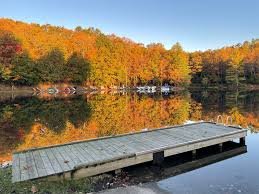
Brevard
Brevard and Transylvania County — Nicknamed “The Land of Waterfalls” for its 250+ named falls, Transylvania County and the Brevard corridor deliver western NC’s most dramatic waterfall-and-foliage combination. The US-276 corridor through Pisgah National Forest past Looking Glass Falls, Sliding Rock, and Moore Cove Falls turns into a golden tunnel of color in mid-October. DuPont State Forest’s Triple Falls and Hooker Falls — both filming locations for The Hunger Games — are surrounded by hardwoods at peak.
Hot Springs and Madison County — The most underrated fall foliage corridor in western NC. Hot Springs sits at 1,300 feet in the French Broad River valley, completely wrapped in ridges that turn above the town through October. Fifteen minutes from town, Max Patch delivers the most open-sky fall panorama in the state — a 4,629-foot grassy bald where the surrounding forest goes crimson and gold in every direction with no trees obstructing the view. See our Max Patch guide for trail options.
NC High Country — Boone, Blowing Rock, Banner Elk
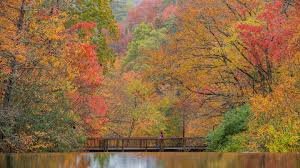
Banner Elk
The NC High Country in the northwestern corner of the state offers some of the highest-elevation fall color outside of the Pisgah/Parkway corridor. Grandfather Mountain at 5,946 feet and Beech Mountain at 5,506 feet — the highest town east of the Rockies — both begin turning in early October, among the first spots in the state to show color. The peak timing for this area runs October 10–25, with Boone at 3,333 feet and Blowing Rock at 3,500 feet peaking mid-month.
Linville Falls at Blue Ridge Parkway milepost 316.4 is one of the most photographed waterfalls in NC in any season — but in fall, when the gorge below the falls turns deep crimson and burgundy, it becomes genuinely extraordinary. The 22-mile Blue Ridge Parkway corridor from the Linn Cove Viaduct south to Linville Falls is widely called the best fall foliage drive in eastern North America and deserves that reputation.
NC Piedmont — Triangle, Triad, and Charlotte
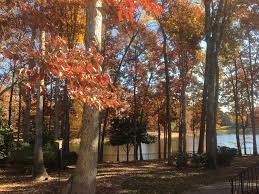
Charlotte
North Carolina’s central Piedmont — Raleigh, Durham, Chapel Hill, Greensboro, Charlotte — doesn’t get the foliage attention that the mountains do, but it has its own fall color season that peaks in late October through early November as the color descends from the Blue Ridge. The tree mix is different here: more oaks, sweetgums, and red maples dominate at lower elevations, producing a warmer, more orange-and-gold palette than the crimson-heavy mountain forests.
For Piedmont residents, the best fall foliage options are accessible day trips: Eno River State Park and Umstead State Park near Durham offer uncrowded trail walks through good color in late October. Falls Lake has excellent late-season foliage viewing. But the serious fall color experience requires heading west — the Blue Ridge front is a 2-3 hour drive from most Piedmont cities, and the difference in color intensity is substantial.
NC Coast — The Quiet End of the Season
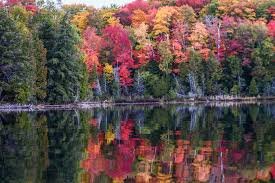
Outter Banks
The North Carolina coast has a fall foliage season that most residents don’t know about. By early November, the coastal plain’s sweetgums, oaks, and maples add subtle oranges and golden yellows. The Great Dismal Swamp on the Virginia border and Croatan National Forest near New Bern are the best spots for coastal fall color — quiet walks among turning leaves without a tourist in sight. This isn’t the dramatic mountain show, but it’s genuinely pleasant and almost entirely uncrowded.
North Carolina Fall Foliage Peak Timing — The Full Calendar
NC Fall Foliage Peak by Elevation — 2026 Estimates
Late September — Above 5,500 ft: Beech Mountain, Grandfather Mountain summit, Mount Mitchell. First color in the state. Often sparse but early for those who want first look.
Early October — 5,000–5,500 ft: Graveyard Fields, Black Balsam Knob, Craggy Gardens, Max Patch, Waterrock Knob. High balds and ridge forests. Peak for early-season foliage chasers.
October 10–15 — 4,000–5,000 ft: Most of the Blue Ridge Parkway corridor. Linville Falls, Crabtree Falls, Linn Cove Viaduct area. Sweet spot for Parkway drives.
October 15–22 — 3,000–4,000 ft: Boone, Blowing Rock, Highlands, Cashiers. Most of the mid-elevation mountain towns. Peak week for Boone and the High Country.
October 20–31 — 2,000–3,000 ft: Asheville, Waynesville, Brevard. Biltmore Estate. French Broad River valley. City-level foliage at its best.
Late October–Early November — Under 2,000 ft: Hot Springs (1,300 ft), French Broad River corridor, Chimney Rock, Lake Lure. Last color of the mountain season.
Late October–Early November — Piedmont: Raleigh, Durham, Charlotte. More muted but still worthwhile. Eno River, Umstead State Park.
Early November — Coastal Plain: Croatan National Forest, Great Dismal Swamp. Subtle and uncrowded. End of the statewide season.
The Best North Carolina Fall Foliage Drives
Blue Ridge Parkway — 252 miles through NC: The definitive NC fall foliage drive. No stoplights, no commercial development, ridge after ridge of color with overlooks every few miles. Complete guide at our Blue Ridge Parkway fall foliage guide.
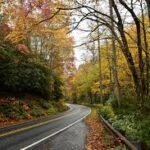 US-276 — Forest Heritage Scenic Byway (Brevard to Waynesville): The most waterfall-dense fall foliage drive in NC. Looking Glass Falls, Sliding Rock, Moore Cove Falls — all framed in October color. The road becomes a tunnel of gold and orange at mid-month.
 NC-209 — The Rattler (Hot Springs to Lake Junaluska): 234 curves, 36 miles, Madison County. The most underrated fall foliage drive in western NC. Almost no traffic, ridge-to-valley elevation transitions, late October peak. Dave’s 209 restaurant is the halfway stop.
Nantahala Scenic Byway (Bryson City to Marble): 45 miles through Nantahala National Forest following the Nantahala River. Mid-to-late October peak. Joyce Kilmer-Slickrock Wilderness along the route has old-growth trees — some of the largest yellow poplars east of the Mississippi — turning gold in fall.
Where to Stay for North Carolina Fall Foliage
 Where you stay for North Carolina fall foliage depends entirely on which part of the season and which region you’re targeting. For the Blue Ridge Parkway and Pisgah corridor, Asheville and Brevard are the most central bases. For the High Country and Grandfather Mountain, Boone and Blowing Rock put you closest. For the Smoky Mountains end of the Parkway, Waynesville or Cherokee.
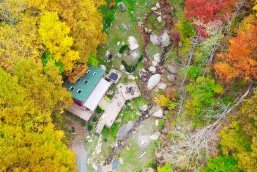
For the Madison County corridor — Max Patch, Hot Springs, The Rattler, and the French Broad River valley — the most private and immersive fall foliage stay in all of western NC is Windows Over Waterfalls. A private waterfall cabin on 4 secluded acres in the mountains above Hot Springs, 15 minutes from Max Patch and 20 minutes from Hot Springs. Multiple waterfalls run the full length of the property. In October, the surrounding forest turns around the cabin while the creek runs cold and clear below. A hot tub above the water. Two fire pits. Thirty-eight windows and skylights pulling the fall color inside from every angle. One booking at a time. The whole property is yours. Book direct at windowsoverwaterfalls.com.
Airbnb designates this as a top 10% home — their designation, not ours · Guest Favorite · Superhost
What Airbnb Guests Are Saying
★ 4.97
243 Five-Star Reviews
243 Reasons to Book With Confidence
As of June 2026 — and still growing.
Planning a Fall Wedding or Elopement in North Carolina?
The same property hosts private waterfall ceremonies through our sister site — all-inclusive elopement packages from $4,400 with photography, florals, officiant, hair & makeup, and more.