
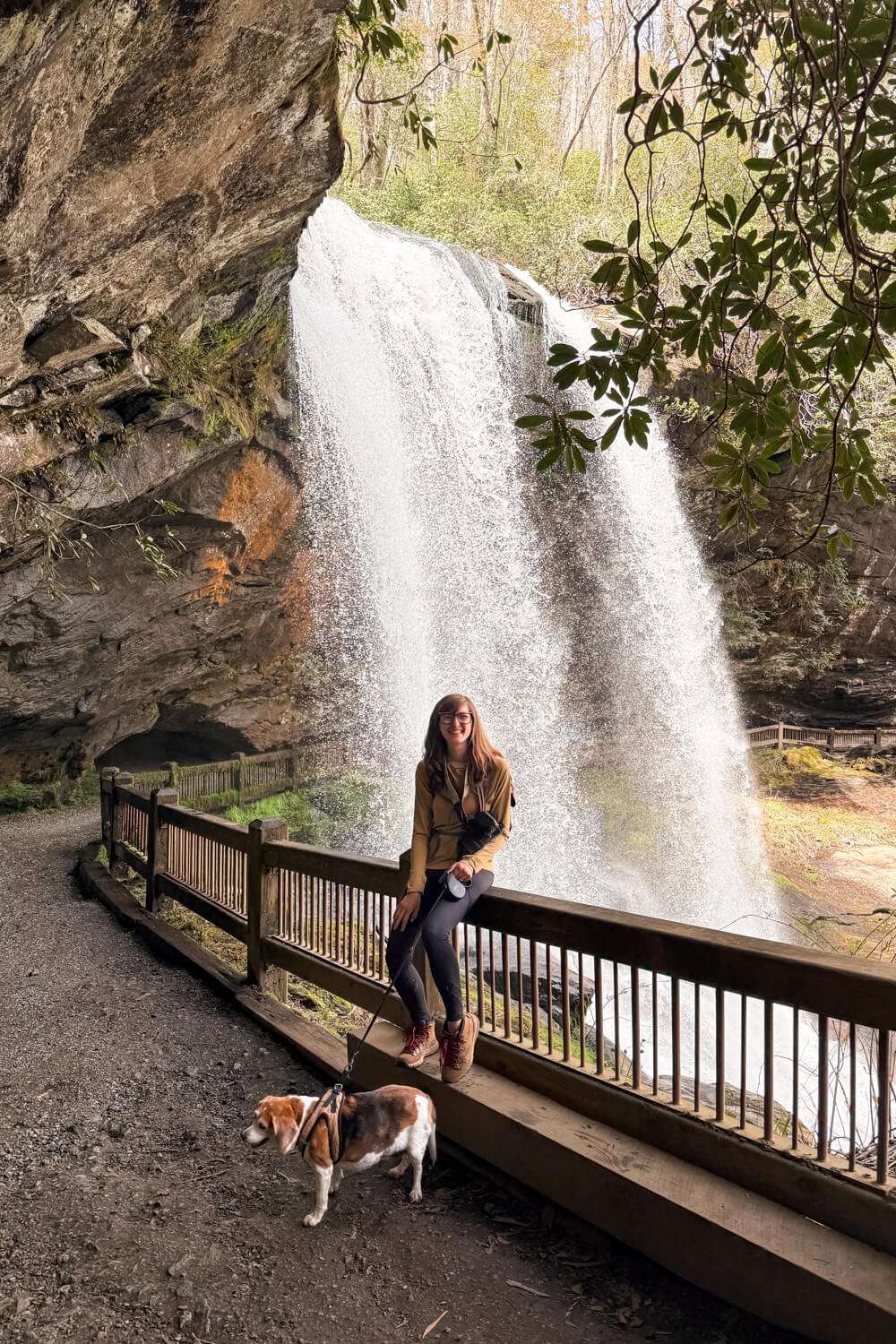
A North Carolina waterfall road trip through the western mountains can deliver more falling water per mile than almost anywhere else in the eastern United States. Transylvania County alone holds the official nickname “Land of Waterfalls” with over 250 named falls inside its borders, and the surrounding counties — Haywood, Henderson, Jackson, Madison — each add their own concentrated stretches. The result is a region where a single day of driving, with a handful of short trailhead stops, can take in more waterfalls than most states have in total.
This guide lays out the best routes for a North Carolina waterfall road trip — organized by how much time you have, from a tight day-trip loop near Brevard to a multi-day itinerary that spans the full width of the mountains.
North Carolina Waterfall Road Trip — At a Glance
Best single-day loop: US-276 Forest Heritage Scenic Byway near Brevard — 4 waterfalls in 10 miles
Most waterfall-dense county: Transylvania County — 250+ named falls, official “Land of Waterfalls”
Highest-traffic stop: Looking Glass Falls — roadside, 40,500+ monthly searches, free
Best swimming stop: Sliding Rock — natural 60-ft water slide, fee in summer season
Best filming-location stop: Triple Falls, DuPont State Forest — Hunger Games scenes
Best extended route: Either Linville → Brevard → Cashiers/Highlands, or the reverse — Brevard is the midpoint, not the starting point
Best base if extending toward Asheville: Hot Springs NC — quiet, private waterfalls on-property
Fewest crowds: Weekday mornings before 9am, any route
Cost: Nearly every stop on this route is free; Sliding Rock charges a seasonal fee
The Classic Day Trip — US-276 Forest Heritage Scenic Byway
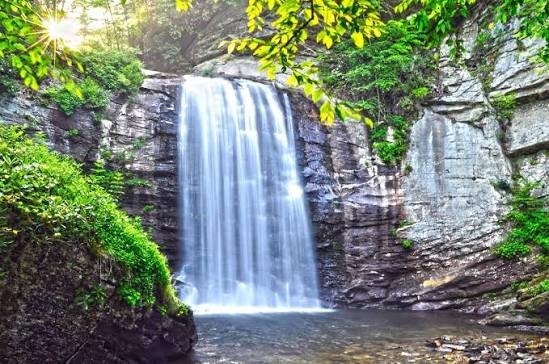
Looking Glass Falls
If you only have one day, this is the route. A 10-mile stretch of US-276 through Pisgah National Forest between Brevard and the Blue Ridge Parkway packs four major waterfalls into a corridor short enough to drive in under 30 minutes — without the stops.
Start at Looking Glass Falls, about 6 miles north of Brevard — a 60-foot plunge waterfall visible from the road, with a paved 30-step staircase to a wide viewing area at the base. It’s the single most visited waterfall in North Carolina and the natural anchor for the whole trip. For the complete visitor guide, see our Looking Glass Falls NC guide.
sliding rock
Continue 1.5 miles north to Sliding Rock — not a traditional waterfall but a 60-foot natural granite water slide on the same creek, ending in a deep, cold pool. A fee is charged Memorial Day through Labor Day when lifeguards are on duty; free and unguarded the rest of the year.
Moore Cove
Half a mile further, pull off for Moore Cove Falls — a 0.7-mile round-trip trail to a 50-foot walk-behind waterfall. Most road-trippers skip this one entirely because it requires actually parking and walking rather than viewing from the car. That’s the reason to stop.
Graveyard Fields Skinny Dip Falls
End the loop at Graveyard Fields on the Blue Ridge Parkway (MP 418.8) — a mile-high valley with two more waterfalls, an open meadow, and wild blueberry fields. The full corridor, start to finish with stops, takes 4-5 hours including hiking time. For the complete waterfall picture across the whole Pisgah district, see our Pisgah National Forest waterfalls guide.
Road-tripping the NC waterfalls? Windows Over Waterfalls puts you a short drive from this entire corridor — with your own private waterfalls waiting at the end of the day. Check Availability →
Add DuPont State Forest for a Fuller Day
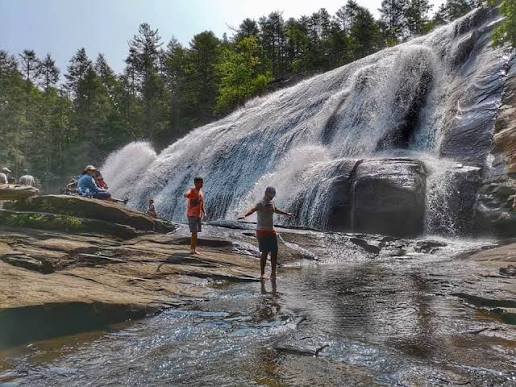
Twenty minutes southeast of Brevard, DuPont State Recreational Forest adds three more major waterfalls to the same general loop — and they’re arguably the most photogenic on this entire list. A single 2.2-mile loop from the Hooker Falls parking area takes in
Triple Falls
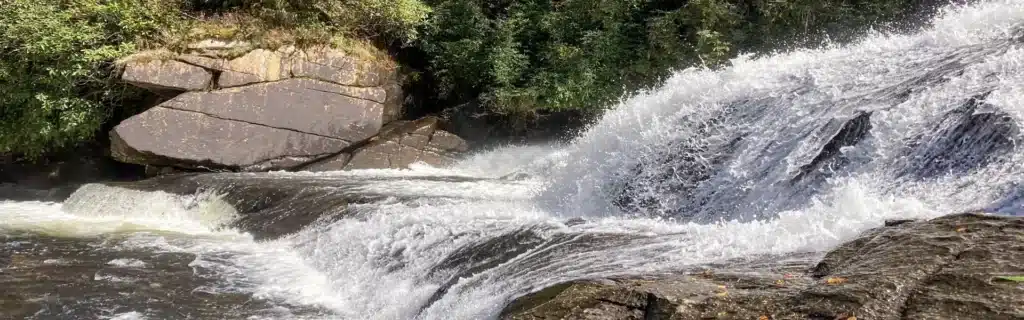
Triple Falls (125 ft, three tiers, a Hunger Games filming location),
High Falls
High Falls (150 ft, the tallest in DuPont, with a covered bridge above), and
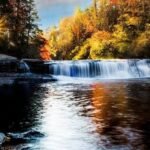
Hooker Falls Dupont
Hooker Falls (12 ft, wide, with the most popular natural swimming pool in the area). Combining the US-276 corridor with a DuPont stop turns a half-day trip into a genuinely full one — and still costs nothing beyond gas and time.
The Extended Route — Linville and Cashiers/Highlands
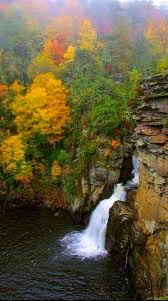
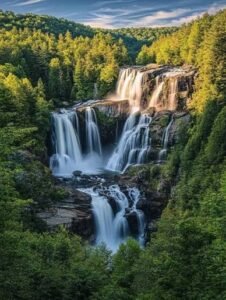
Linville and Cashiers/Highlands sit on opposite sides of Brevard, about 75 miles northeast and 40 miles southwest respectively, and the two are well over 100 miles apart from each other. There’s no single loop that hits all three without serious backtracking — pick the direction that fits where the rest of your trip is headed.
Where to Eat Along the Route
A waterfall road trip lives or dies a little on the food stops, and this route has good ones. In Brevard, start the day with coffee and a pastry from one of the small bakeries on Main Street before heading out to Looking Glass Falls — nothing on the trail corridor itself sells food, so eat before you go. Heading toward Linville, options thin out considerably along the Blue Ridge Parkway; pack a cooler with sandwiches and snacks, since the closest real meal options sit in Boone or Blowing Rock at the end of that leg. Heading toward Cashiers and Highlands instead, both towns have a surprising number of good restaurants for their size — Highlands in particular has an upscale small-town dining scene worth building a stop around, a nice contrast to the more rustic feel of the rest of the trip.
Photography Timing Across the Route
Each major stop on this route photographs best at a different time of day, which is worth knowing if photography is part of the draw. Looking Glass Falls faces in a direction where morning sun hits the falls directly — arrive before 10am for the cleanest light, or come on an overcast day when the lighting is even regardless of the hour. Linville Falls works well in either morning or afternoon light depending on which of the five overlooks you choose, since they face different directions across the gorge. DuPont’s Triple Falls and High Falls are framed by forest canopy that softens harsh midday light, making them more forgiving than the open Parkway overlooks if you’re stuck shooting in the middle of the day. Dry Falls is one of the few spots on this route where you can shoot from behind the water itself — overcast days work best there since direct sun behind the falls tends to blow out the highlights. If the trip extends into fall, the entire route — especially the Blue Ridge Parkway leg and the Cullasaja Gorge — peaks for color in mid-to-late October, and the lower sun angle that time of year tends to produce better light at almost every stop than the same locations in summer.
What to Pack
Road Trip Packing List
Water shoes: For Sliding Rock and Hooker Falls if swimming is on the agenda — the rocky entries are uncomfortable barefoot.
A small cooler: Food options are sparse along the Blue Ridge Parkway leg toward Linville — pack lunch if that’s your direction.
Cash: Sliding Rock charges a seasonal fee that may not always take cards at the gate.
Offline maps: Cell service drops out completely in stretches of Pisgah National Forest and along the Parkway.
A dry bag: For phones and cameras near any of the swimming stops — the mist alone at Looking Glass Falls and Triple Falls is enough to soak an unprotected phone.
Layers: Elevations along this route swing from under 1,500 ft in Brevard to over 4,000 ft on the Parkway and around Highlands — temperatures can differ by 15–20 degrees between stops on the same day.
A printed or downloaded trail map: AllTrails works well for this route specifically and most of the trailheads listed here are mapped on it.
North Carolina Waterfall Road Trip — Practical Tips
Before You Go
Cell service is unreliable: Download offline maps (AllTrails, Gaia GPS, or Google Maps offline areas) before entering Pisgah National Forest or DuPont.
Weekday mornings win: Looking Glass Falls and Sliding Rock both fill their lots by mid-morning on weekends. The same stops on a Tuesday before 9am are nearly empty.
Most of this trip is free: Looking Glass Falls, Moore Cove Falls, Graveyard Fields, DuPont’s falls, Crabtree Falls, and Linville Falls all have no admission fee. Sliding Rock charges seasonally, and both Whitewater Falls and Dry Falls charge a small parking fee (around $3 per vehicle).
Pack water shoes: If swimming is part of the plan — Sliding Rock, Hooker Falls — sturdy water shoes make the rocky entries far more comfortable.
Fall and spring both work, for different reasons: Spring brings the highest water volume after snowmelt and rain. Fall brings the best color framing the falls, typically peaking mid-to-late October across this route.
Check road conditions: The Blue Ridge Parkway closes sections for ice, storm damage, or maintenance. Check nps.gov/blri before heading toward Linville.
Where to Stay on a North Carolina Waterfall Road Trip
Brevard works as a base for the midpoint stretch — closest to the highest concentration of falls. Near the Linville end, Boone or Blowing Rock work well for an overnight. Near the Cashiers/Highlands end, Highlands itself makes a fine overnight, or loop back to Brevard the same evening since that leg is under 80 miles round trip.
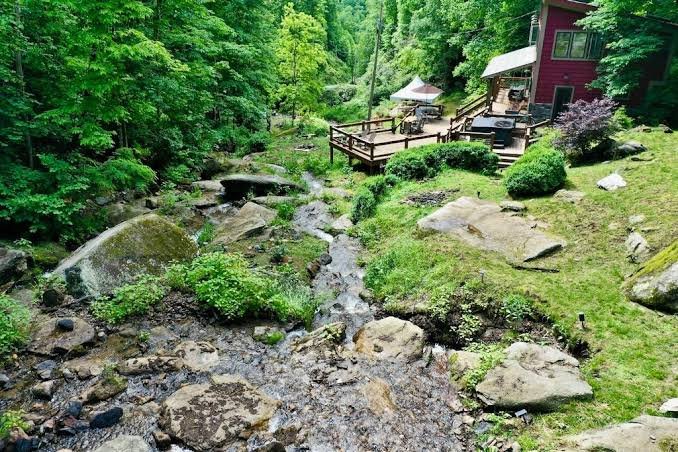
If the trip continues toward Asheville afterward, or if a quieter close to the trip appeals more than another hotel, Windows Over Waterfalls sits about an hour north of Asheville in the mountains above Hot Springs — a private cabin on 4 secluded acres with its own waterfalls running the full length of the property. After days of driving to waterfalls, ending somewhere the waterfall is simply outside the window changes the rhythm of the whole thing.
Airbnb designates this as a top 10% home — their designation, not ours · Guest Favorite · Superhost
What Airbnb Guests Are Saying
★ 4.97
254 Five-Star Reviews
Read the reviews there, then book direct here and skip Airbnb’s guest service fee.
As of October 2026 — and still growing.
Planning a Waterfall Wedding or Elopement in NC?
The same property hosts private waterfall ceremonies through our sister site — all-inclusive elopement packages from $4,400 with photography, florals, officiant, hair & makeup, and more.